how i shipped 67 prs to @codercops for hacktoberfest 2026
october 28, 2026
what i built, fixed, and learned while contributing to codercops during hacktoberfest 2026.
how it started
i started contributing to open source in late september 2026, right before hacktoberfest officially kicked off. i wanted projects that were actually active, had clear issue labels, and welcomed first-time contributors.
i found codercops while browsing goodfirstissue.dev and up-for-grabs.net. what stood out was the contributor workflow. labeled issues across chatcops, ogcops, toolbelt, and discord-bot, so there was always somewhere to start.
there was also a dedicated "hacktoberfest 2026: start here" issue. it laid out exactly what counted and how to get involved, so no guessing.
contribution overview
repositories i contributed to
| repository | what it does | my contributions |
|---|---|---|
chatcops | universal embeddable ai chatbot widget (multi-provider: claude, openai, gemini) | 24 merged prs. built redis and cloudflare storage adapters, session token signing, turnstile verification, and fixed accessibility issues around pre-chat labels and form validation. |
ogcops | free og image generator with 120+ templates and a rest api | 20 merged prs. shipped 10+ new templates (table of contents, newsletter, podcast, gift card, etc.) and fixed social preview sharing, cors, and hex color normalization. |
toolbelt | privacy-first browser developer tools (json formatter, jwt decoder, base64, invoice generator) | 17 merged prs. built the color converter and contrast checker, added guides for jwt and base64, fixed markdown preview language extraction, and added lighthouse ci performance budgets. |
discord-bot | community bot that tracks releases, starter issues, merged prs, and leaderboards | 6 merged prs. added cors to json leaderboard errors, made logins readable on mobile, fixed the no-card page, and added a /help command. |
the numbers
- first merged pr: chatcops #102 · merged around october 7, 2026
- total merged prs in codercops at time of writing: 67
the work that mattered most
fix #1: redis storage adapter
repo: chatcops · pr: #256
problem: chatcops needed a proper redis storage adapter. the issue was about supporting redis and upstash for conversations, counters, and events, but there was no implementation.
what i changed: i implemented @chatcops/store-redis from scratch. it supports upstash and ioredis, uses atomic lua operations, and has configurable key prefixes and conversation ttls. i also added tests, vercel setup docs, and a changeset. the event system uses pre-aggregated hourly count hashes instead of redis streams because it handles out-of-order historical timestamps better.
result: merged. the reviewer ran it against redis 7 and the upstash emulator, all 46 conformance tests passed with nothing skipped, and coverage was 99% lines and 86% branches. he also tested 5,000 messages in one conversation without trouble.
fix #2: cloudflare storage adapter
repo: chatcops · pr: #296
problem: chatcops needed cloudflare storage support. the issue asked for d1-backed conversations and events, optional workers kv, and durable object counters.
what i changed: i added @chatcops/store-cloudflare with d1 as the primary store, optional kv, and durable objects for counters. i wrote miniflare conformance tests, added wrangler config docs, and a changeset.
result: merged. the reviewer noted the schema matched the sqlite store table for table, and the append logic got atomicity right. 1,034 tests passed, with 97% line and 88% branch coverage for the new store.
fix #3: color converter and contrast checker
repo: toolbelt · pr: #188
problem: toolbelt was missing a color tool. the issue asked for a browser-based converter for hex, rgb, and hsl with wcag contrast checking.
what i changed: i built the color converter as a client-side tool. it supports alpha values, copy buttons, and aa/aaa ratings for normal and large text. everything runs locally with no network requests. i also added unit tests for conversions, alpha parsing, invalid inputs, and contrast math.
result: merged after a round of review feedback. the reviewer confirmed the conversions and contrast math were correct, and the build passed all 284 tests with no console errors in dark mode.
beyond my own prs: reviewing contributions
partway through hacktoberfest, anurag, the founder of codercops, messaged me on discord. i had 15 prs merged at that point, and he asked if i'd review other contributors prs on top of shipping my own.

the job was simple. when a first-timer opens a pr, i pull the branch, check it against the issue's acceptance criteria, and leave a comment on what works and what's missing. he still does the final approval and merge, and there are no fixed hours.
until then, my contributions were just patches. reviewing meant understanding the codebase well enough to judge someone else's approach, catch edge cases, and give feedback that actually helps a pr get merged.
it also made my own prs better. i started writing clearer descriptions, adding context for reviewers, and answering the questions i'd normally ask someone else before they had to ask me.
external recognition: the xerj email
one of my chatcops prs, #129, led to something i didn't expect. an email from ivan, the founder of xerj, an open-source search engine that gives coding agents the exact passage of code or docs they need instead of making them guess.
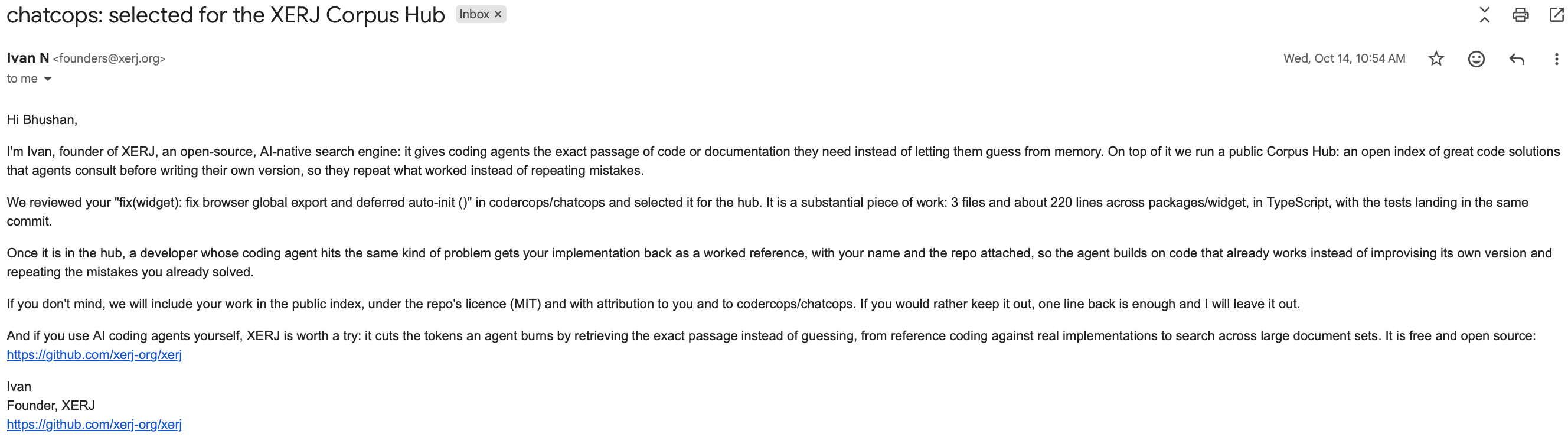
xerj runs a public corpus hub, an open index of good code solutions that agents check before writing their own. ivan reviewed my "fix(widget): fix browser global export and deferred auto-init" pr and picked it for the hub. it was 3 files and about 220 lines of typescript, with the tests in the same commit.
he asked if he could add it to the public index under the repo's mit license, with attribution to me and codercops/chatcops. if a dev's agent hits a similar problem, it gets my implementation back as a worked reference.
this was the clearest sign the work mattered outside the original repo. a widget fix was clean enough that a founder building agent tooling wanted it in his index.
it also changed how i think about prs. the audience isn't only the maintainer who merges it.
what i learned
read the codebase before writing a line
i first tried to patch the inputs in chatcops #102 at the component level. then i read the surrounding code and realised the fix actually belonged in the widget's core validation state so it could clear error attributes properly.
that change came from reading first. the patch i would have written an hour earlier would have worked and been wrong.
reviewing is a different skill from writing
when you write a fix, you can skip explaining it because you already know why it's right. reviewing took that away.
i had to say why something was a problem, not just go fix it myself. that's harder, and it made me better at both.
small prs get merged faster
the prs that merged within a day were scoped to one concern, with a clear before and after. the reviewer never had to ask what the pr was trying to do.
open source is social, not just code
the discord conversation with anurag and the xerj email both came from being visible. i showed up in discussions, responded to feedback, and wrote prs people could understand quickly.
nobody finds good work they can't read. making it legible is part of the job.
what's next
hacktoberfest ends this month, but i'm not stopping when it does. the streak was never the point.
i'm staying with codercops and i'd rather go deeper in repos i know than hop around for a badge. i'll keep reviewing first-timer prs too. it's the part that taught me the most, and new contributors keep showing up.
i also want to try other orgs. different codebases, different review styles, different conventions. i learned a lot from one org's workflow and i want to see how others do it.
on the contribution side, i'm going after harder issues. less "fix a typo", more "understand why this breaks and fix it where it belongs". the provider layer fix taught me that's where the real learning is.
links
- codercops org: github.com/codercops
- my github profile: github.com/bhushan4work
- the xerj project: github.com/xerj-org/xerj
- hacktoberfest official site: hacktoberfest.com
- where i found the issues: goodfirstissue.dev and up-for-grabs.net
thanks to anurag, the codercops maintainers, and everyone who reviewed, commented, or merged along the way.